


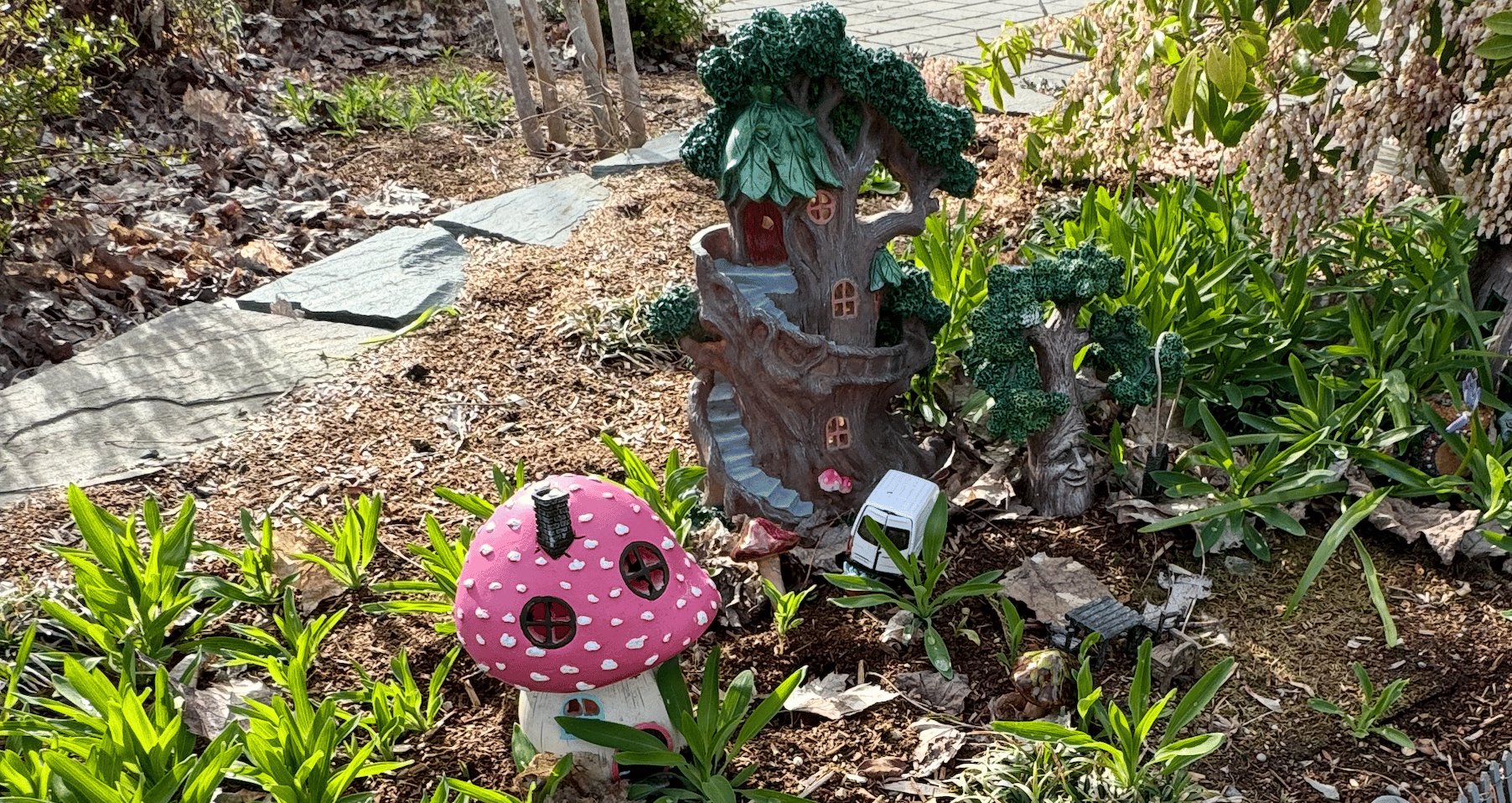
I live in a magical land of fairy gardens.
It's true. Walk down my street and you'll spot tiny doors tucked under trees, miniature houses below rose bushes, fairy dwellings hidden in hedges. Nearly every other house has one. It's particularly fun with a toddler, watching them hunt for each tiny world.
I have no idea who started this or why. But it's one of those things that makes our neighborhood feel special. Connected.
This is the same neighborhood where someone organized a food drive for the U-District Food Bank over Thanksgiving. The same one that throws an end-of-summer block party with a live band and potluck dinners. (We brought a cotton candy machine, naturally.)
The same neighborhood that hosts Monday happy hours from Memorial Day to Labor Day for anyone within a ten-block radius who wants to show up.
The same neighborhood that shows up for its single moms, widows, widowers, and struggling families without being asked.
It’s not like there is a big committee or HOA that runs all this. There is no formal structure. Just people who decided that living near each other should mean something more than sharing a zip code.
Last night we were putting up our Christmas lights and the lovely older couple from a couple blocks away walked by. We talked about how festive the neighborhood gets, our cat that likes to greet people walking by (they asked about her by name at this point), the nice weather. And when we were done and back inside, I felt it. That quiet shift. More solid. More here.
Turns out, there's a name for that feeling. And it explains why humans have been gathering around fires, throwing festivals, and building communities for thousands of years.
So this week, let's talk about collective effervescence, what it is, why it matters, and how you can find more of it in your own life.
What Is Collective Effervescence Actually?
I know, collective effervescence sounds like something you'd find at Whole Foods next to the kombucha. Or perhaps a craft beer brewed by someone with a handlebar mustache. But it's actually a sociological concept that explains one of the most fundamental human experiences.
French sociologist Émile Durkheim coined the term in 1912. Durkheim, considered one of the founding fathers of sociology, spent a lot of time studying how societies hold themselves together. And he was particularly locked in on religious gatherings and rituals, trying to figure out what made them so powerful for people.
What he found wasn't so much about religion but more about what happens when humans come together.
Durkheim noticed that when people get together for shared experiences, something in us shifts. He described it as electricity generated from closeness, where individual concerns fade and you feel part of something larger than yourself.
And I suspect you've felt this. The shared gasp when someone scores a last-second goal. Or that moment at a concert when thousands of people are singing the same words at the same time. You're not just watching or participating. You're synchronized. Connected. Present in a way scrolling never quite achieves.
It likely barely registers in your conscious mind, but you sure do remember the feeling afterward.
But collective effervescence is more than just caught emotions. It's the experience of unity itself. The brief dissolution of "me" into "us." And according to Durkheim, this isn't some nice-to-have social bonus. It's how humans have survived and built civilizations for thousands of years.
We need this. Not metaphorically. Actually need it.
Which brings us to the question: why?
"Forming and maintaining positive social connections is a fundamental human need, not just a preference."
Roy Baumeister, Need-to-Belong Theory
Why Your Brain Needs Other Humans (Even When You Don't Feel Like It)
Collective effervescence isn't just a nice idea from 1912 like the Titanic or the Oreo cookie. It's a real, measurable thing.
Researchers have spent the last few decades studying what happens when people gather for shared experiences. And the results are pretty clear: social connection isn't a luxury. It's a fundamental human need, right up there with food, shelter, and love.
Stanford neuroscientist Ben Rein argues in his book "Why Brains Need Friends" that our brains treat social contact as a survival need. When you're isolated for too long, your brain starts sending the same distress signals it would send if you were hungry or thirsty. The absence of it can register as a threat.
It’s why people with strong social connections tend to have lower rates of depression and anxiety. They handle stress better. They report higher levels of meaning and purpose. They even live longer.
And the flip side is equally clear. Social isolation and loneliness are linked to worse mental health outcomes, higher rates of physical illness, and increased mortality risk. Not slightly worse. WAY worse. The U.S. Surgeon General's 2023 advisory on loneliness compared social isolation to smoking cigarettes in terms of health impact.
Think about that for a second. Lack of connection doesn't just make you sad. It makes you sick. It shortens your life.
Which helps explain why so many of us feel a bit off since 2020. We got used to staying home. We learned we could work remotely, order groceries, stream everything. And a lot of that is convenient. But we also lost something we didn't realize we were losing.
The Monday happy hours. The office birthday cakes. The standing coffee dates. The pickup basketball games. All those small, regular moments of being around other humans doing human things together.
Your brain noticed. Even if you didn't.
So when you feel that pull toward isolation, that instinct to skip the gathering or cancel the coffee date or stay home instead of going to the block party, your brain is lying to you. It's telling you that rest means being alone. But what you actually need is the opposite.
Remember that activation energy we talked about a while back? The effort it takes to get started? Social connection works the same way. The hardest part is showing up. But once you're there, the energy flows the other direction.
How to Actually Get More of This (Without Overthinking It)
Okay, the good news is that you don't need to join a drum circle or start taking tango lessons. Collective effervescence doesn't require grand gestures or too much commitment. It just requires showing up.
Start with what already is out there. I bet your neighborhood probably has something going on. There might be a book club at the library. A running group that meets Saturday mornings. A volunteer shift at the food bank. Find something out there and put it on your calendar and go. At least once.
You don't have to commit forever. You don't have to make best friends. You just have to be in the room with other humans doing something together.
If nothing exists, create the smallest possible version of something. Text three neighbors and suggest coffee on your porch. Organize a casual happy hour at a local bar. Start a monthly pizza night where everyone brings their kids. The fairy gardens in my neighborhood didn't start with a committee. Someone just put one out, and others followed.
The idea here is to try and establish some kind of rhythm. One-off events are fine, but regular gatherings give you more bang for the buck. Weekly is ideal. Monthly works. The predictability matters almost as much as the gathering itself. Your brain starts to expect it. Plan around it. GASP, even look forward to it.
A few practical starting points:
Say yes to one invitation you'd normally decline this month. Just one. See what happens.
Find one recurring event and commit to it for three months. Give it time to become part of your routine.
If you host something, make it stupid easy. Pizza and beer in your backyard counts.
Show up even when you don't feel like it. Especially when you don't feel like it. That's usually when you need it most.
Bring someone with you. Collective effervescence is contagious. Your friend who's also been isolating needs this too.
The goal isn't to fill your calendar. It's to have regular touchpoints with actual humans.
Some buddies of mine meet almost every Thursday at the same bar. I used to go pretty consistently and then somewhere along the way I just…stopped. Well guess who’s back baby!? I started popping in. Sometimes I have to drag myself there. They start at around 8:30pm (that’s dangerously close to my bedtime) and it takes me about 15 minutes to get there. But time and time again, I am happy I went. Even for just a little bit. It reminds me there's more to life than my couch and my laptop.
Turns out Durkheim was onto something in 1912. Modern neuroscience just gave us the receipts. Your brain needs this. So go get it.
The Thing About Fairy Gardens
Here's the fun little secret about these gardens: they're not really about fairies at all.
They're invitations to stop and look. To bring your kids to hunt for them. To strike up a conversation with the person watering their roses about the tiny door they installed last spring.
They're also a choice. Someone deciding to put something small and beautiful into the world, knowing others might notice.Just one person signaling "I'm here, and I think this matters," and a neighborhood responding "we're here too." It’s part of why people like our tree so dang much.
That's collective effervescence in tiny little action. Not the big concert or the religious ceremony Durkheim studied, but the daily, unglamorous version. The Monday happy hours. The Christmas lights conversations. The end-of-summer block parties with the world’s best cotton candy.
So go out and find your fairy gardens. The small, regular thing that invites connection and pulls you out into the world.
Your brain will thank you. Your neighbors will too. And maybe, without realizing it, you'll help build the kind of community that makes someone else feel less alone.
That's not magic. That's just humans doing what we've always done best.
Ever forward.
— Derek (aka Chief Rabbit)
Oh and hey!
I made a new friend, Amanda Gustafson. She supports unconventional people in making career pivots through human to human connection. Learn how to skip the job application game with her free 3 Steps to Drastic Career Pivots without Starting Over.
Enjoying Chief Rabbit?
This newsletter is free and always will be. But if you’d like to support this work, you can. You’ll get monthly Q&As, vote on topics, stickers, and help keep this ad-free.
You can also follow me on Threads where I sound off on all sorts of nonsense OR LinkedIn where I tend to be a touch more serious.
Also, thanks for being someone who reads to the bottom of the page, you’re a special human.
I love this post Derek! I think you and Mr. 1912 are on to something!😄