

“Are you happy?” If you’ve ever read Fahrenheit 451, you might remember when Clarisse asks Guy Montag this question early in the book, and it more or less ruins his life.
I know the feeling.
I am not happy. I don’t wake up happy. I wouldn’t call myself a happy person. I wake up stressed, to be honest. I have legit anxiety-related ailments. Stress rashes. Did you know that was a thing? Stress rashes! But lately I think I am something beyond happy. I am fulfilled. I feel more complete than I have in a while.
There’s nothing quite like hanging your own shingle. So many plates spinning. But goddamn, it feels good too.
In my old life, I was an owner. One of the big bosses. But I was also the third man down, and the top two were not the kind of people you’d want to work for. They were... difficult human beings. The company felt it. It was rough. Toxic. I was stifled at almost every turn. I was also, I think, mostly asleep. The role was comfortable. It came with all the usual dopamine wins. Easy to stay.
But now, despite the struggles that come with building something new, I am awake. Fully awake for the first time in a long time. Learning, driving, helping, making a difference, and profoundly appreciated for it. But it might be something better.
So this week, let’s talk about the two kinds of happiness, why one of them keeps you asleep, and how the other keeps you awake at night but in the best way possible.
Aristotle Gonna Aristotle
You guys up on your ancient Greek philosophers? In case you aren’t, my guy Aristotle kinda figured out this whole happiness thing about 2,300 years ago.
He said there are two kinds of happiness, and we keep using the same word for both, which is sort of like calling a Kit Kat and a steak “dinner” and wondering why you’re still hungry.
The first kind is hedonic happiness. Hēdonē in Greek. Pleasure. Hence the word "hedonist," which should give you a clue where this is going. It’s the dopamine hit. A good meal, a funny show, a glass of wine, a scroll through your feed when you should be doing literally anything else. It feels not terrible. But it also disappears the second the buzz wears off.
It’s not nothing. It’s just rented.
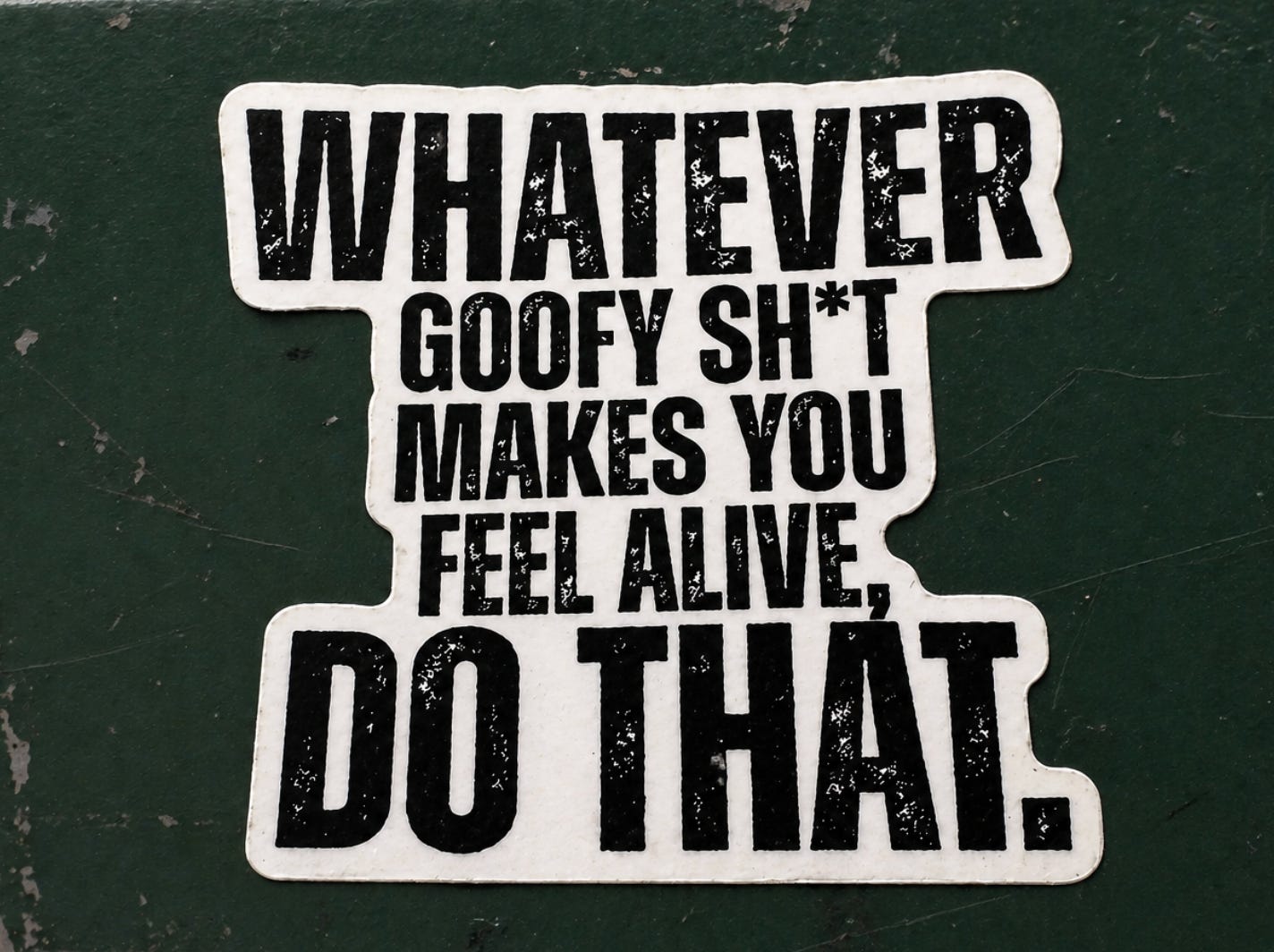
The second kind is eudaimonic happiness. The literal translation is something like “good spirit,” but he didn’t mean it as a mood or a vibe. He meant it as a way of being. A life that’s actually pointed at something. Doing work that matters. Using what you’ve got. Being useful. It is not a feeling that happens to you. It is something you just do.
It is a thing that is earned, not given. Aristotle thought you couldn’t get there without sacrifice and effort, which is why most people don’t really gravitate toward this. It’s hard.
Hedonic happiness is cheap. Eudaimonic happiness is expensive. And they both more or less feel like happiness from the inside, which gets confusing.
Aristotle said you can’t actually know if your life was eudaimonic until it’s nearly over. You only get to look back and see if it added up to something. Not a great afternoon. Not a fun summer. The whole arc of your existence. We live, we die, and the wheels on the bus go round and round. That’s the whole shape of a life. Aristotle was just asking the obvious question. While the wheels are turning, what’s the ride for?
But if your happiness disappears the moment the pleasure ends, was it ever really happiness, or just a feeling that wore the same name?
HEY hold up! I’ve got a daily newsletter that breaks down AI, one term at a time. Think of it like a word of the day for AI terminology. 60 seconds a day to help you sound like you know what you’re talking about.
Give it a look ⤵︎⤵︎⤵︎

The Comfortable Coma
Hedonic happiness is great. Until it isn’t.
A comfortable life with regular dopamine wins is a real thing. The job is fine. The paycheck clears. The weekend has a plan. There’s a show to watch and a thing to look forward to and a snack in the cabinet. Nothing is on fire. You aren’t sad. But it is also possible that you also aren’t really living.
And this is the trap. Don’t get me wrong, life is hard enough, we all need comfort. Comfort is fine. But comfort is meant to be a break, not a residence.
I can say this because I lived in it for years. I had a title that mattered. I had a paycheck that worked. I had wins on a regular enough basis that my brain, my soul, stayed quiet. The leadership team was difficult, the company was rough, but I had built a routine that gave me just enough small hits to keep the bigger questions off my desk.
And pretty much the whole time, I was asleep. I was in a comfortable coma. Not in pain and not really all there. The job wasn’t always that way, but it devolved over time. I didn’t even know I was asleep. That’s how good a coma can feel.
I think this is why so many people describe a quiet emptiness in lives that look, from the outside, completely fine. But something is missing, and they can’t name it. They reach for another drink. Another scroll. Another...something. Hoping the right combination of small pleasures will eventually add up to a feeling of meaning.
Aristotle would tell you it won’t.
The Sleeper Has Awakened
If you’ve read this far, you might be thinking well no sh*t Sherlock. Cause yeah, I suspect most people know this. You don’t need me to diagnose you. But I suspect you might wonder what you can do about it.
That’s the harder problem.
I’ve been spending a lot of time lately with the Japanese concept of ikigai. Loosely translated, it means “a reason for being.” It’s that thing that drives you. It sits at the overlap of what you love, what you’re good at, what the world needs, and what someone will pay you for. I’m not going to do justice to ikigai here. It deserves its own piece. But I bring it up because the framework points at something I am finding to be true: a meaningful life isn’t just one thing. It’s a confluence of a lot of things, lined up just right.
You don’t need ikigai today, but you do need a starting place. If you’re trying to figure out what waking up looks like for you, start here:
What are you actually good at? Not what’s on your resume. What do people come to you for? What could you do a TED Talk on, or at the very least, what could you riff on for ten minutes without notes?
What does your corner of the world actually need? This isn’t always obvious. It takes a working layer of awareness, but it helps to pay attention to the areas where you keep wanting to fix something.
And one more, this one a bit more from Aristotle than from ikigai:
What matters enough that you’d keep doing it even when it costs you? This is a bit of a litmus test. Hedonic happiness ends when it stops being fun. Eudaimonic effort doesn’t. If there’s something you’d keep showing up for even on the hard days, there’s a there there...as they say.
Your version of waking up probably won’t look like mine. It might be the side project you keep almost starting. The conversation you keep almost having. The thing you keep telling yourself you’ll get to “someday.” Waking up doesn’t always require a leap. Sometimes it just requires a step.
But it does require a step.
In Conclusion
Not too long ago I would have told you that I was happy. Or at least that I had a close approximation of happiness. And from the outside, the life looked like a life.
But I was Montag, before Clarisse (and without all the book burning).
Look, I’m not telling you to blow your life up or anything. Hedonic happiness is a thing. We all need the show, the snack, the long lazy weekend, the dumb pleasure of a thing that asks nothing of us. Comfort is a gift.
But don’t mistake comfort for happiness. A life made entirely of small pleasures will feel okay for a long time, and then one day, someone you barely know will ask if you’re happy, and you won’t know how to answer.
So this week, try asking yourself the question. Honestly. Out loud if you have to.
Are you happy?
And if the answer is no, or you aren’t sure, or you just can’t answer, don’t panic. Just sit with it. The question doesn’t need an answer this week. It just needs to be asked.
Cause remember that hedonic happiness fades. Eudaimonic happiness endures. And oftentimes people spend a life choosing the wrong one.
Ever Forward,
— Derek (aka Chief Rabbit)
Life is good, GOP is evil
loved it