


A couple of years ago, my wife went to Bali.
Not a “let’s go see temples and eat Indonesian fried rice” kind of trip. This was a structured retreat with a group of women she’d never met. Days of meditation, journaling, and the kind of intensive self-reflection that only happens when you’re 8,000 miles from your kitchen and your to-do list. A journey to stillness, they called it.
She came back a little different. More like someone had adjusted her contrast settings. Colors were a little more vivid. Boundaries were a little more firm. And she kept talking about this triangle.
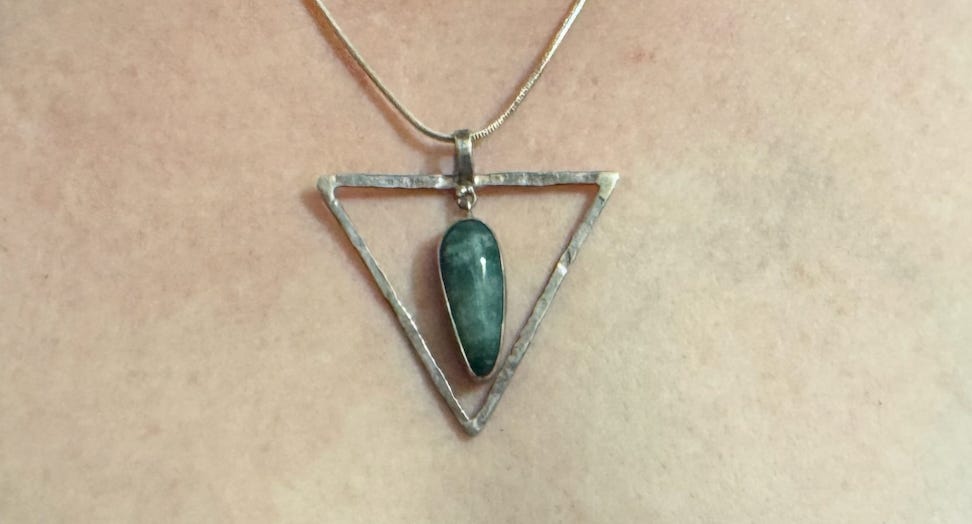
The Triangle of Personal Power. Three corners, three states. At any given moment, you’re doing one of three things with your power: giving it away, taking it back, or standing in it.
She told me about it over dinner. I could see it landed for her. Like a tuning fork had been struck somewhere deep and was still humming. She’d made a necklace while she was there. Not bought. Made. Sat down with a silversmith, pounded the metal, picked out the gem. The whole nine. It was her reminder, her totem. She’d reference the triangle in conversations. It clearly MEANT something to her.
And being the supportive husband that I am, I listened. I nodded. I asked questions. I said all the right things.
But truthfully I didn’t really get it.
I wanted to. I so wanted to. She’d bring up the triangle and I’d do my best impression of a person having a breakthrough. Yeah, honey. That’s great. I love that for you. But it felt like being handed a tool I couldn’t figure out how to use. Like someone giving you a torque wrench when you don’t even know what a torque wrench is for (no one does BTW).
And the thing is, I should have gotten it. I’ve written about power. I quote books on power. Understanding power dynamics is kind of my whole jam. But this framework? It just bounced right off me.
Then everything fell apart. My life got turned upside down. And as I grieved, and struggled, and raged (oh, how I raged), my wife would occasionally check in. Not nagging, not lecturing. Just a quiet question: Where are you in your power right now?
And slowly, the triangle started to make sense. Not because someone explained it better. Because I was finally living inside of it.
There’s a saying that gets attributed to Buddha, Lao Tzu, and perhaps Zorro: “When the student is ready, the teacher will appear.” The best lessons don’t come from a single source. They show up when you’ve been softened up (read: pummeled) enough to receive them.
So this week, let’s talk about personal power, what it really means, why we give it away so easily, and how you can start standing in yours.
Why We Give It Away
You almost never hand over your power all at once. There’s no dramatic moment where you hand someone your keys and say “you drive.” It’s more like this slow leak. A thousand tiny surrenders that barely register on their own.
You say yes when you really wanted to say no way. Someone else’s bad mood rewires your entire afternoon. You apologize for something that didn’t require an apology. Small stuff. Barely worth mentioning.
But then there are the sneaky ones.
Scrolling your phone and letting an algorithm decide how you feel for the next two hours. Not asking for what you want when you already know exactly what you want. Sitting in a room full of people and not sharing your idea because you’ve already decided you’re the least qualified person there. Giving a painful memory the microphone and then wondering why you feel so small.
None of these feel like giving your power away. They feel normal. They feel polite. Some of them even feel responsible. And that’s exactly why they work so well.
By the end of the week, you’re running on empty and you can’t even point to where it all went.
What Taking It Back Actually Looks Like
Taking your power back is not a montage. There’s no training sequence or inspirational soundtrack, no moment where you stand on a mountain and declare yourself healed. A lot of the time it’s quieter than that. And it takes longer than you want it to.
For years, I worked with people who didn’t see me. I don’t mean I was invisible. I’m loud. I’m always there. I’m pretty hard to miss. But my input, my ideas, my vision, my direction? Those were easy to overlook. I didn’t go to the fanciest college (go Northern Colorado Bears!). My degree is in communications. I came to technology through food service. I don’t have an MBA. My skills were “soft,” which made them easy to discount.
And for a long time, that really bothered me. My confidence was tied to recognition I wasn’t going to get. I kept waiting for someone to look at my work and say, yes, this guy gets it. I was handing my self-worth to people who didn’t even know what they were holding.
But over time, something started to shift. I began to realize that the people holding me to some invisible, ever-changing standard didn’t actually know me at all. Their measurements had nothing to do with my value and everything to do with their own insecurities. And I had years of adding value with the receipts to prove it.
That awareness didn’t arrive all at once. It crept in. But once it did, I stopped hoping for approval that was never going to come. I realized I could trust evidence over the opinions.
That’s one way to take your power back. It’s not a declaration. You don't need a patch on your arm or anything. It’s a decision you make so quietly that nobody notices but you. You stop auditioning for people who were never going to clap.
But awareness is just one part of the process. And it’s the relatively easy part. The hard part is what comes next.
You set a boundary and watch someone get annoyed by it.
You say “no, that doesn’t work for me” and everybody gets kinda quiet.
You stop apologizing mid-sentence and the people around you don’t quite know what to do with this new version of you.
There’s this awkward retraining period for everyone in your life, including yourself. Especially yourself. Because when you’ve been the person who always says yes, always smooths things over, always makes it easy for everyone else, choosing yourself feels like breaking a contract nobody remembers signing.
The hardest part of taking your power back isn’t knowing you should. It’s that it feels wrong when you do. You’ve been giving it away for so long that keeping it feels selfish. It’s not. It just feels that way until it doesn’t.
Standing In Your Power (And Staying There)
So yeah, standing in your power, it’s not really a destination. There’s no finish line. It’s more like balance. You find it, you lose it, you find it again. The skill isn’t staying perfectly centered. The skill is noticing when you’ve drifted.
Standing in your power doesn’t mean living without fear and it certainly doesn’t mean you have all the answers. But it does mean you know who you are and you stop asking other people to confirm it.
It’s the difference between walking into a room and thinking I hope they like me versus I know why I am here and what I bring to the table. Between reacting to everything that comes at you and choosing what actually deserves your energy.
And the people who do it well? They don’t look the way you’d expect. They’re not the loudest. They’re not the most aggressive. They’re typically the calmest person in the room. The one who can disagree without making it a battle. The one who can sit with silence and not rush to fill it.
My wife still asks me that question from time to time (okay often). Where are you in your power right now? It’s a deceptively simple check-in. And I’ve started asking it of myself. Usually the need to ask is actually the answer. If I’m spinning about something someone said, I’m likely giving it away.
But if I can just be still without performing or defending or apologizing…
That's me standing in it. So steal my wife's question. When something rattles you, when you feel yourself getting smaller or louder than you actually are, pause and ask: where am I in my power right now?
In Conclusion
Power is a funny thing. It’s this quiet currency that you spend without realizing it. If you can wield it, you can do amazing things. But when you lose it, you just feel smaller. And you can’t always explain why.
And it’s honestly not something I think a lot of us think about. When we think of power we think of an electrical grid or some political drama on TV. Or maybe oppression, or politics. It can be an uncomfortable concept to sit with.
But my wife came back from Bali and started to normalize the consideration of it. To understand that you exist in varying states of power almost all the time. And that taking power and holding it for yourself is not selfish. It’s healthy.
The part I originally missed was that this isn’t a framework you study. It’s one you feel. You can read every book on power ever written (and I’ve read a few) and still miss it completely. Because knowing about power and knowing where yours is are two very different things.
So if this whole triangle thing sounds a little too retreat-in-Bali for you, I get it. I was you. But try the question anyway. Just once this week, when you feel off, when something is gnawing at you and you can’t name it, ask yourself: where am I in my power right now?
You might not like the answer. But I am willing to bet you’ll know exactly what to do with it.
Ever forward,
— Derek (aka Chief Rabbit)
Oh hey, kinda random but I've got a new daily newsletter that breaks down AI, one term at a time. Think of it like a word of the day for AI terminology. 60 seconds a day to help you sound like you know what you're talking about.
Check it out ⤵︎⤵︎⤵︎

"When the student is ready, the teacher will appear."
I'm at this part:
*You set a boundary and watch someone get annoyed by it.
*You say “no, that doesn’t work for me,” and everybody gets kinda quiet.
*You stop apologizing mid-sentence, and the people around you don’t quite know what to do with this new version of you.
Thanks for being my teacher and my friend. You are a blessing.
Oh, and thank your wife for the second-hand lesson. <3