


There’s an episode of G.I. Joe from 1986 that just sorta exists in my mind.
Alright, stay with me. Cobra (they’re the bad guys) hacks the Defense Department and they fake promotion orders, bumping soldiers (actually they’re called Joes) Shipwreck, Dial-Tone, and Lifeline EACH UP TO COLONEL! The plan is to destroy G.I. Joe from the inside by wrecking morale and screwing up the whole command structure. The episode is titled “The Most Dangerous Thing in the World,” which I’m guessing has something to do with putting the wrong people in charge.
When Hawk (who I think at this point is a Brigadier General) gets back from wherever he was, he reviews the damage and delivers a brutally honest assessment. Lifeline has the skill but not the will. Dial-Tone has the will but not the skill. And Shipwreck...oh Shipwreck, well he has neither.
Then there’s a fun little life lesson and then roll credits with “Now you know. And knowing is half the battle.”
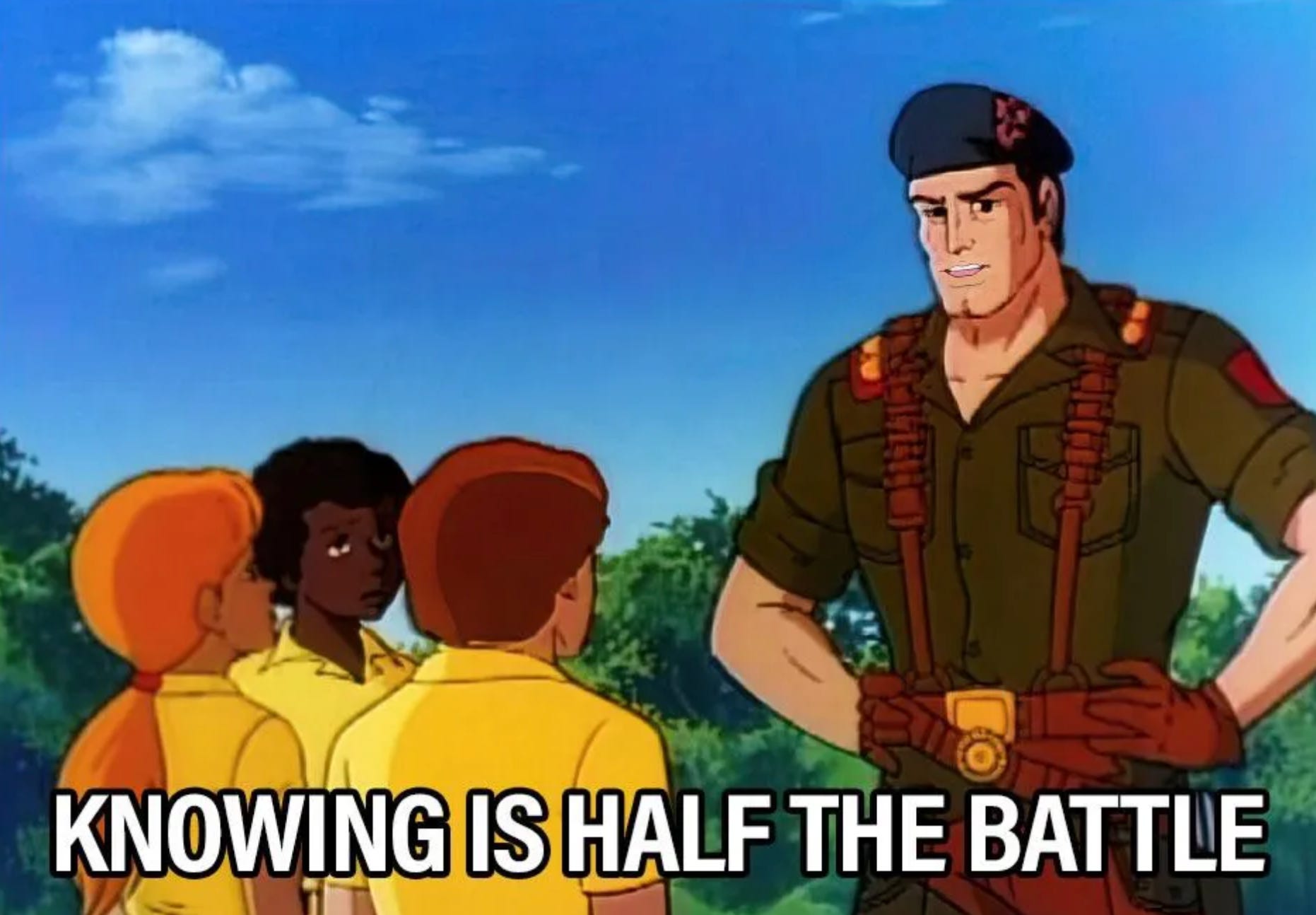
I was 12 or 13 at the time, watching alone in my living room after school, and I remember thinking, “Wow, Hawk is kind of a jerk.”
But some 40 years later, I’m still chewing on it all. Skill alone isn’t enough. Motivation alone isn’t enough. And wanting neither the responsibility nor the command does not a leader make. Three guys, three different gaps between what they could do and what they wanted to do (honestly, they should have just promoted Lady Jaye and called it a day, but I digress).
But, I’ve thought about Hawk’s little leadership quadrant more times than I’d like to admit, usually in the context of wondering which one I am in at any given moment.
Turns out there’s a name for what Hawk was doing. Psychologist Gay Hendricks calls them zones. Four of them in fact. And they map pretty dang well to that cartoon I watched in 1986.
So this week, let’s talk about your zone of Genius, what it is, why it matters, and how to figure out if you’re actually living in yours.
Meet The Four Zones
Hendricks laid this out in his 2009 book The Big Leap. It’s a framework for sorting the work you do into four buckets based on how good you are at it and how much it lights you up. I can’t help but wonder if Hendricks also watched a lot of G.I. Joe.
Here’s how the zones break down.
The Zone of Incompetence is the stuff you’re frankly just bad at. You can grind on it for hours and still come up short. For me, it’s most things involving spatial reasoning. Sense of direction, packing a car, figuring out how to put together that damn IKEA bookshelf. My wife has things like this down while I’m still squinting at the instructions. This is Shipwreck territory, no skill, no will...please stop putting me in charge of assembling things!
The Zone of Competence are the things you can do fine, but so can a lot of other people. You’re not bad, but you’re not particularly special. You’re a perfectly serviceable adult getting the thing done on an unremarkable Thursday. Go you. Writing a professional email. Cooking a weeknight dinner. Driving in traffic without losing your mind. It’s more or less the zone of “well, somebody had to do it, and today it was me.”
The Zone of Excellence is where the rubber starts to meet the road. This is work you’re genuinely good at, often better than most people around you. It’s earned you raises, promotions, and perhaps a certain reputation. You might even claim to have a very particular set of skills. It’s why people hire you and it looks like the finish line. It isn’t. We’re going to come back to this one.
Finally, we have the Zone of Genius. This is where what you’re great at and what you love doing meet. The work that doesn’t feel like work. The thing where, if you stopped doing it, the world would be slightly worse off. It is pretty similar to Ikigai which I swear I write about one of these days. Hendricks argues this is where you’re meant to spend the bulk of your time, and most of us don’t.
The catch is that you can do excellent work for years and years without ever touching your Zone of Genius. Excellence is a form of comfort. Genius is not.
And that gap matters.
Why Excellence Isn’t Enough
The more I think about it, the more I’m convinced my old job lived in the Zone of Excellence. I was really good at what I did. Running projects, leading people, working at the intersection of knowledge and technology. Sometimes it felt close to amazing.
But now that I’ve been away from it for a while, I can say pretty clearly: It was killing me. It was absolutely f’ing killing me.
Cause there’s a funny little thing about Excellence. You can be genuinely great at something, getting paid enough, getting promoted, getting the title, and still slowly drying up inside. The trouble is, everything around the work looks okay. The metrics look good. Perhaps the reviews are glowing. But somewhere underneath all of that, the will is quietly, slowly, assuredly, leaking out of you.
Without curiosity or challenge, without something that pulls you forward instead of just propping you up, it doesn’t matter how excellent the work is. Excellence without will, without passion, is just a very comfortable prison. The bars are made of paid time off and not too terrible benefits.
Last week I told a young engineer (who I respect immensely) that he could spend the next 20 years just doing what he’s doing. Cozy. Comfortable. Paid just enough. And then wake up one day and wonder why he’s miserable.
This is Lifeline’s problem from Hawk’s quadrant. Skill, but no will.
(As an aside, his name is Lifeline cause he’s a medic. GI Joe was very on the nose, not a lot of subtlety.)
This is hardest one to spot from the outside because nothing actually looks overtly wrong. But from the inside, you know something’s off, and you can’t quite name it. You just keep showing up, keep doing the work, keep getting the bonus, keep telling yourself this is what success looks like. But there is an uncanny valley here. A feeling of wrongness you can’t quite name.
And maybe it’s fine. There’s nothing wrong with that, most people are fine. But it’s not the same as being in Genius. Confusing the two is how a lot of us end up decades later wondering where the time went and why the win doesn’t feel like a win at all.
Finding Your Way to Genius
I mean, I’ll be honest here. I don’t have this figured out.
I’m on a path. I’m pretty sure I can see Genius on the horizon. But I’m not living in it, and to be frankly most of the time I’m still sorting through what belongs in which zone for me.
These days I build things for people. I consult. I teach. I write (hopefully you like what I write). I’m trying a lot of things on at once and seeing what fits. Some of it lives in Competence. Some of it lives in Excellence. A few moments, here and there, feel like they might live in Genius.
Like I might be in it when I’m in front of an audience. In a workshop, in a classroom, on a Zoom call with the little cameras on. I can work a room. I can take a complicated idea and make it feel relatable, even funny. And man I love doing it. The kind of love where you’re disappointed when the time is up. I feel like that is trying to tell me something.
Cause that might be the thing about Genius. I suspect you feel it before you can name it. The body knows first. The work doesn’t drain you the same way Excellence (or Incompetence) does.
So I not quite sure what to tell you here dear reader. I think that if you want a place to start sorting your own work, here are a few questions that might be worth sitting with:
What do you do that makes time disappear? Not the work that takes a long time. The work where you look up and three hours have passed and you just did not even notice.
What do you do that other people thank you for in a way that surprises you? Genius often looks effortless from the outside, which is why you might be undervaluing it.
What kind of work leaves you with more energy than you started with? Excellence (or Incompetence) drains. Genius refuels.
What were you doing the last time you felt fully like yourself at work? Not productive. Ya know, just yourself. Just you.
None of these will hand you a map. But maybe you’ll start to notice the difference between work you can do and work you should be doing more of.
Truthfully, getting from Excellence to Genius is probably not a straightforward kind of leap. For most of us it’s a slow trek. You start saying yes to one thing and no to another. You take on a project that lights you up and notice you don’t dread the start of the week for a couple weeks in a row. You write a thing, teach a thing, build a thing, and it feels less like work. Feels more like getting plugged in and recharging.
I dunno.
Yo hold up! I’ve got this daily newsletter I write that breaks down AI, one term at a time. Think of it like a word of the day for AI terminology. 60 seconds a day to help you sound like you might just know what you’re talking about.
Give it a look ⤵︎⤵︎⤵︎

Conclusion
I know. GI Joe isn’t really the place most people go for life lessons.
And yes Hendricks’ The Big Leap came out 17 years ago. That framework has been sitting on book shelves for almost two decades, while I had to go and figure out, slowly, that I needed it. It’s amazing to me that General Hawk got there first when I was 13. In fairness, Hawk is a cartoon.
But I think there is a reason the Joes have been hanging around in my consciousness. Cause I am still wondering which zone I’m in on any given day, but I want to figure this out. I want to get to Genius. It feels urgent to me. Because if you wait, all that happens is that you get older.
So pay attention to the work that makes time vanish. Pay attention to the rooms where you light up. Pay attention to the projects you’d do for free if paying bills weren’t a thing. Not because you have to quit your job tomorrow. But because the slow trek toward Genius is the most worthwhile thing most of us just are not doing. And the more you pay attention, the more you learn. The more you might start to know something important about yourself.
And as they say, knowing is half the battle.
Ever Forward,
Derek
Oh hey, quick aside: If you’re getting value from this newsletter and want to support what I’m building, consider upgrading to a paid subscription. You’ll get stickers (yes, actual stickers), support this work, and the satisfaction of knowing you helped fund my questionable police car choices.