
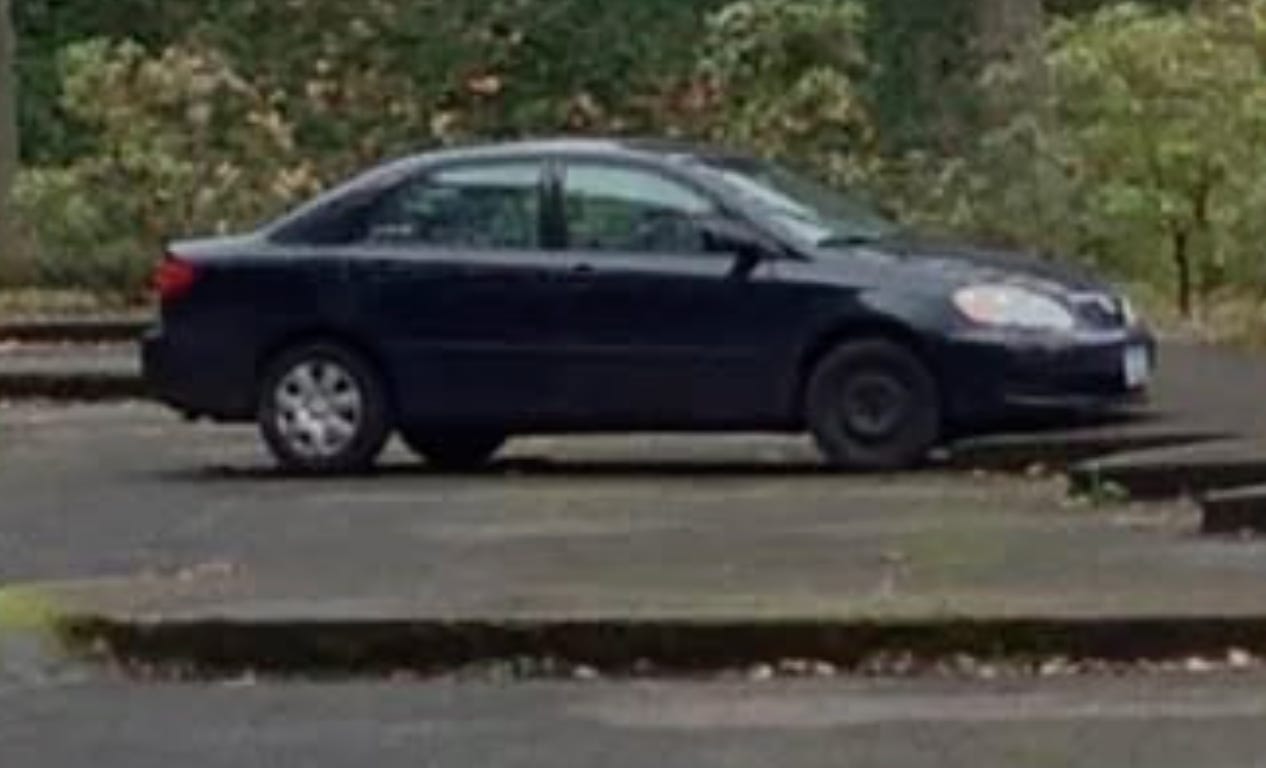
Did you know that older model Toyota Corollas lose their hubcaps more than any other car?
A few years back I noticed this phenomenon. At first it was a simple curiosity, a naked wheel here and there. But over time I picked up on the trend, and before I knew it I was seeing Corollas with a missing hubcap (or two!) pretty much every day. In traffic, on walks, in parking lots. I don’t want to say I was obsessed, but I was definitely fixated.
Enough that it started to bother me. Surely this was a thing. So I did some digging. There was nothing official from the corporate fat cats at Toyota, who I was sure were covering this up all the way to the top. No recall notices. No government reports. Nothing in the New York Times, the Washington Post, or the Chicago Tribune. The best I could find was a Facebook group dedicated to the cause, and it had seven followers. Seven. That, and a WordPress blog where some guy spent the spring of 2013 photographing hubcapless Corollas around Portland. How could no one else be talking about this?
Then one day I counted four, yes four! Corollas with missing hubcaps in a two block radius. I was astounded. So astounded I went back to double check, and found I’d miscounted. One of them was a Honda Civic.
You can guess what happened next. Over the following days I started seeing Civics with missing hubcaps too. Corollas and Civics, quietly propping up the entire American hubcap industry. Of course, you might not be too surprised to learn that there is actually nothing wrong with the hubcaps on these older cars. There was no ongoing defect, no hubcap scandal, no coverup.
There’s a name for what my brain was doing, and it oddly involves German terrorists from the 1970s. So this week, let’s talk about the Baader-Meinhof phenomenon, what it is, why it matters, and how you can make it work for you.
The Guy in Minnesota
The Baader-Meinhof phenomenon, more or less known in science circles as the frequency illusion, is a cognitive bias where something you just learned about suddenly appears everywhere. A word, a concept, a car. The thing isn’t actually appearing more often. Your brain just became hyper-aware of it.
You buy a Subaru Outback and now every third car on the road is a Subaru Outback. (Okay, bad example. I live in Seattle, so every third car in this town is legally required to be a Subaru Outback.) The point is, the Outbacks didn’t multiply. Your brain just started flagging them.
So how does this originate with German terrorists?
Quick history. The Baader-Meinhof Gang was a real militant group in 1970s West Germany, responsible for bombings, kidnappings, and bank robberies. They had opinions about capitalism and, as far as anyone knows, none whatsoever about cognitive psychology.
In 1994, a guy named Terry Mullen wrote a letter to a Minnesota newspaper about a weird coincidence. He’d come across the name of the group “Baader-Meinhof” for the very first time, and within 24 hours he’d spotted them in print again. He figured the weirdness deserved a name, declaring “I have dubbed it The Baader-Meinhof Phenomenon.” He submitted it under the pen name “Gigetto on Lincoln,” which was his dog’s nickname, as one does. And it went kinda viral, or as viral as anything could go in Minnesota in the mid-90s before the internet. Readers kept writing in with their own versions of the same experience, recently learned words and names suddenly showing up everywhere. And the name stuck.
The official term came later. In 2005, a Stanford linguist named Arnold Zwicky coined “frequency illusion,” on his blog. Accurate, responsible, and about as memorable as that hubcap blog guy in Portland. Basically, there’s a reason people still call it the Baader-Meinhof phenomenon.
Here’s what’s actually happening. Your brain runs a filter called selective attention, and that filter decides what gets through to you and what gets ignored. Spoiler, most things get ignored. It kinda has to be that way, or you’d notice all 4,000 fonts you pass in a day and never make it to lunch. But the moment something becomes personally relevant, your brain goes, “oh, we care about this now? Noted.” And it starts paying real close attention.
The Filter Cuts Both Ways
Your attention filter doesn’t care whether the thing it’s flagging is good for you. It just flags what you’ve told it matters. And you’re telling it things all the time, usually without realizing it.
Tune it toward a car, you see the car. Harmless. But tune it toward the idea that you’re unlucky, and your brain becomes a bloodhound for proof. Every red light, every ignored email, every small slight gets logged and filed under “See? Told you.” You’re not imagining those things. They’re real. But so are the green lights and the answered emails, and those slide right past, because you didn’t ask your brain to count them.
This is the uncomfortable version of Baader-Meinhof. The phenomenon that makes you notice Corollas is the same one that can quietly build a case that your life is miserable, your friends are distant, or the world is out to get you. Not because those things are necessarily true, but because you handed your attention a theme and it went looking for supporting evidence. It always finds some.
Your phone figured this out years ago, by the way. The whole business model is noticing what snags your attention and then serving you more of it. Get angry at one outrage clip and the feed goes, “oh, we care about this now? Noted.” It’s the same mechanism, except a company is holding the dial instead of you.
Somebody is always apply that filter. The only question is whether it’s you.
It’s worth asking. What has your attention been collecting lately, without you ever asking it to?
Putting Yourself on the List
So if your filter amplifies whatever it’s tuned to, then perhaps you should tune it on purpose. Name the thing you’re after, and your brain starts flagging paths to it you’d have walked right past.
Quick story. Back in March, Apple announced the MacBook Neo, and being a card-carrying Apple nerd, I had to have it. With the teacher discount, the Blush one came out to around $600. Doable. But I really did not want to just swipe a credit card and pretend that counted as a decision.
So I decided to scrounge for it. And here is where Baader-Meinhof comes in. Once “I need $600” became personally relevant, the money started showing up. Not out of thin air. I sold a bunch of stuff on Facebook Marketplace. I picked up a couple small jobs on Upwork. I found an old Visa gift card from my birthday sitting in a drawer. I cashed in some coin rolls of quarters I’d been ignoring for months. None of that was new. The gift card was already in the drawer. The quarters were already in the jar. My brain just finally started flagging them, the same way it flagged all those Corollas.
To be clear, I did not visualize a laptop until one magiclly appeared on my desk. What actually happened is quieter and more useful.
Focus changed what I noticed.
What I noticed changed what I did.
And the doing is the part that got me there.
Attention finds the doors. You still have to open them.
It took about two weeks. Fun fact, I’m writing this newsletter on that very Blush MacBook Neo right now.
In Conclusion
I never found the Toyota hubcap scandal, on account of it not existing. What I found instead was a brain that will hunt down absolutely anything I hand it. Corollas. Grievances. Six hundred dollars in used crap and quarters. The machinery runs the same no matter what you load into it.
Which means the target is the only real decision you need to make. You will notice something this week. You always do. The question is whether you picked it or it picked you.
So try this. Pick one thing worth noticing this week. Not a car. Something that would actually make your days better if you saw more of it. Small wins. People being decent to each other. Reasons to think the thing might work out. Name it, and let your brain do what it already does best.
Go looking for hubcaps, and I promise you’ll find them.
Ever Forward,
— Derek (aka Chief Rabbit)
HEY hold up! I’ve got this daily newsletter that breaks down AI, one term at a time. Think of it like a word of the day for AI terminology. 60 seconds a day to help you sound like you know what you’re talking about.
Give it a look ⤵︎⤵︎⤵︎