

Have you ever considered why some people are lucky and others not so much?
Why it seems the Fates have anointed some people with every good fortune. Winning lottery numbers, excellent health, great relationships, and opportunities unbound. And other people get the middle seat on every flight of life.
I am not saying I have the answer. I am not saying that I am lucky. There is a solid case to be made for the opposite. But I do believe luck is a certain entity unto itself. It is a being that requires care and feeding. It needs tending. Neglect it, ignore what it wants, and you might find yourself on the wrong end of things. Opportunity, money, and contentment get harder to reach, and you wonder why. So you call yourself unlucky. And a self-fulfilling prophecy kicks off. A loop that spins downward, where each bad thing fuels the story that bad things just happen to you.
In short, you end up feeding the wrong kind of luck. Not on purpose, but through repetition. Through the stories you tell yourself. Through the tiny ways you stop expecting good things to happen.
Okay. You might be rolling your eyes at this point. You might have arguments loaded up about how sometimes terrible things just happen to good people. You might even be ready to write me back and say that I am blaming the victim and how dare I act so high and mighty.
(I can feel some of you composing the angry reply already, and somewhere a thesaurus is being opened to find a meaner word for “privileged.”)
But before you respond, or stop reading, or throw your device across the room, hear me out.
Because this week I want to talk about luck, what it really is, why it matters, and how to feed it on purpose instead of by accident.
The Four Classifications
Okay, right off the bat, you should know there are four types of luck. I am not talking about bad luck, good luck, lucky strikes, or the Joy Luck Club. I am talking about the four classifications of luck.
This isn’t just me talking. It comes from a neurologist named Dr. James Austin, who laid it all out in a 1978 book with the pretty on the nose title of Chase, Chance, and Creativity. Austin’s big idea is that not all luck is the blind, random kind. Some of it answers to what you do.
The first kind is blind luck. Pure chance. The lottery ticket, the falling piano you happened to side-step, the family you were or weren’t born into. You did nothing to earn it and you can do nothing to summon it. Austin’s take is basically: be grateful when it shows up, but otherwise it isn’t something you have control over. So yes, some things do just happen a certain way.
The fourth kind (and yeah I am skipping around) is luck from who you are. Your uniqueness. Austin’s version is luck that just happens to find you because of some rare, specific combination of traits or skills that only you have. For example, if you just happen to be the one person in a 500-mile radius certified in underwater welding, you get the weird underwater welding call. It’s real, but it’s either beyond your control or takes years to build that kind of “luck,” so I’m gonna leave it mostly alone too.
Which leaves the two in the middle. The two that actually move when you push on them. Luck from motion and luck from awareness. These are the ones worth your time, because these are the ones you feed.
The Gretzky-Scott Doctrine
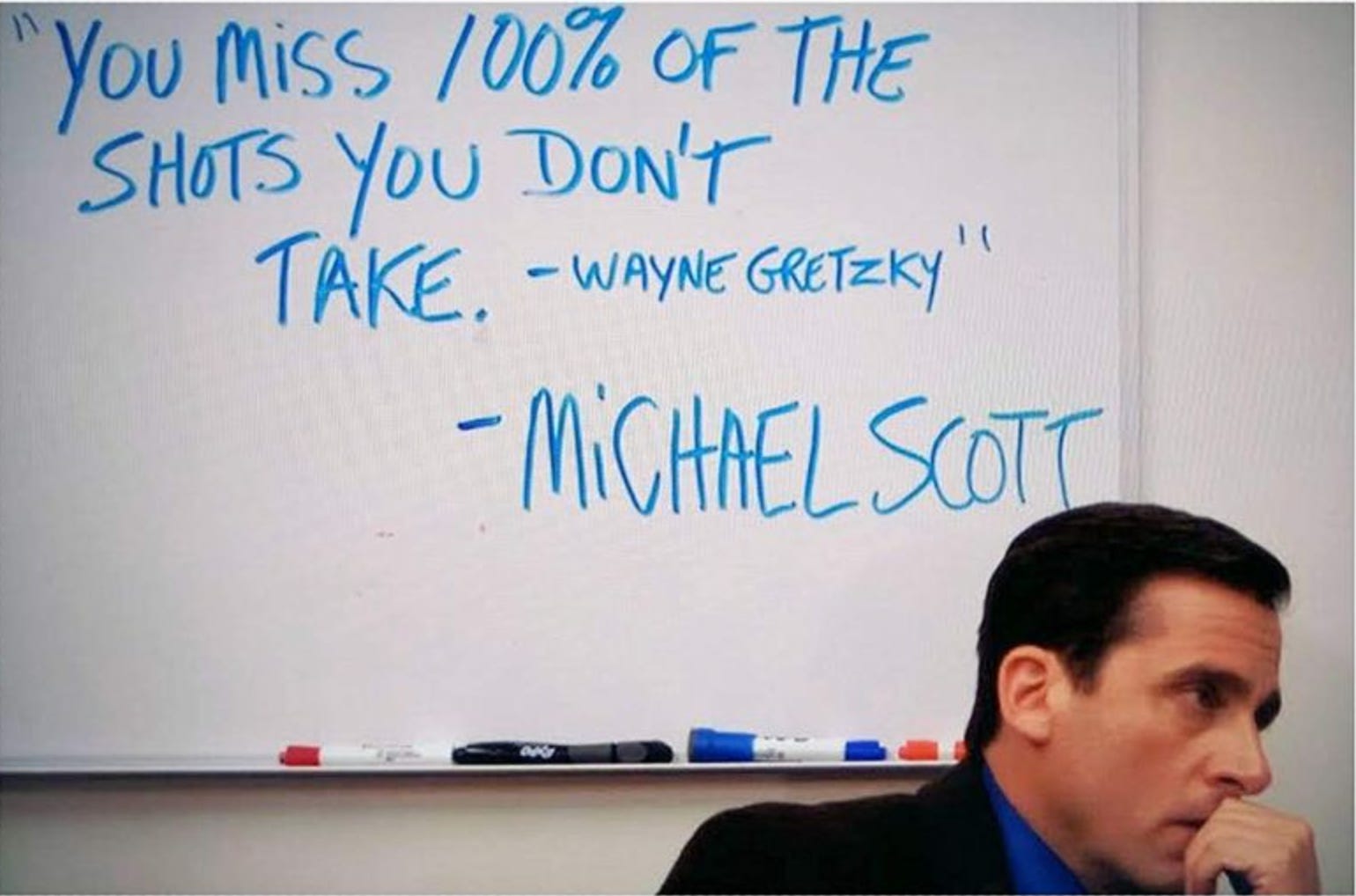
Michael Scott from The Office famously said that you miss 100% of the shots you don’t take. Well, hockey legend Wayne Gretzky said it first, but I think Michael really understood the essence of it more.
This is the second kind of luck: luck from motion. The idea that movement itself, trying things, meeting people, walking into rooms you did not have to walk into, stirs the pot enough that random good things start bumping into each other. You are not controlling the outcome. You are just expanding the surface area of luck. The more you do, the more people you meet, and the more you put into the world, the bigger the target you paint for good fortune.
I remember talking a while back with a friend of mine named Craig. Craig knows everybody and everybody knows him. He is one of those people who just connects people to people. I said something about needing to be better about putting myself out there, meeting new people, opening new doors. Craig said the thing about opening doors is you have to open a lot of them and keep going into new rooms. You open one door, then explore, walk through another, and so on. And often you don’t know until seven open doors later that opening that first door was what mattered. I dunno. It made a lot of sense when he said it.
The first one may look like nothing. You have coffee with someone, or you get introduced to someone new. Another open door is a meetup, or maybe a project you take on just for the experience. But then, a few doors down the line, something just happens. Something opens up for you that never would have happened otherwise. Something incredibly lucky. And if you really examine it, you can trace that luck all the way back to the door chain reaction you started a while back.
That is the part people miss when they call it luck. They see that last door. They don’t count the six before it.
Aware and Lucky
The third kind is luck from awareness. French chemist Louis Pasteur once said, “chance favors the prepared mind.” Okay sure, but I don’t think it’s only about being prepared. I think it’s about being open. Open to the experience in front of you, and open to where it might go.
Awareness is a habit of attention. It is noticing what most people walk past. And for me, it comes down to seeing opportunity in problems, or in the mundane. Two people can see the same thing. Someone hears a customer complain and thinks, “that’s annoying.” Someone with awareness hears the same complaint and thinks, “that’s a business idea.” The opportunity was there for both of them. Only one had the eyes to see it. Of course, I am a touch ADHD, so noticing fourteen things at once is sort of my default factory setting.
So how do you train it? Practice. Practice. Practice.
Awareness is pattern recognition, and patterns only show up once you have collected enough examples to see them. Here are some things to try:
Follow curiosity before it makes sense. When something snags your attention, a phrase you keep hearing, a behavior that shifts, a topic you cannot stop circling, do not wait until you can explain why it matters. Tug the thread and see what happens.
Hang out with people who notice things. Awareness is contagious. Some people walk through the world half-asleep. Others are always noticing patterns, tensions, openings, and changes. Try to spend more time with the second kind.
Ask the second question. So many conversations stop at “so... what do you do?” I like the follow-up questions. What part of that is harder than people realize? What made you go into this? Do you like it? How has it changed recently? I know, it’s like having drinks with The Riddler. But ask them anyway. More often than not something interesting surfaces, and you have quietly trained yourself to turn an observation into a possibility.
Finally, ask yourself what you noticed. At the end of the day, or in a quiet moment (read: on the toilet), ask yourself one question: what did I notice today that others might have missed? The answer might be small. That is fine. You are in training. Just get used to asking.
HEY hold up! I’ve got this other daily newsletter that breaks down AI, one term at a time. Think of it like a word of the day for AI terminology. 60 seconds a day to help you sound like you know what you’re talking about.
Give it a look ⤵︎⤵︎⤵︎

In Conclusion
Anyone who really knows me knows that Dune is one of my favorite books. I do, after all, have the Litany Against Fear tattooed on my arm. But what they don’t know is that one of my favorite quotes from Dune didn’t come from the books. It comes from the David Lynch 1984 movie that, let’s just say, is an experience unto itself.
There’s a scene early on where Duke Leto is preparing to move his family off their home planet, and he explains to his son Paul by saying:
“Without change, something sleeps inside us, and seldom awakens. The sleeper must awaken.”
Later in the movie, Paul drinks a poison that nearly kills him, survives it, and comes out the other side transformed into the Kwisatz Haderach. Basically the messiah, the Lisan al-Gaib... Muad’Dib. (Shut up, it’s a good story.)
Anyway, as he’s about to lead an army of desert warriors into a holy war, he cries out: “Father! The sleeper has awakened!”
And this pretty much all happened because his dad said, we’ve gotten a bit too comfy on this nice ocean planet, let’s go to the most hostile location in the universe and shake things up a bit.
Long story short, the Atreides family was investing in luck. Sure, Leto wasn’t super lucky and a ton of people died, but the point is they stopped sitting still. They fed luck number two and three on purpose, and the universe rearranged itself around that one uncomfortable decision.
You do not need a holy war or a spice planet. But it is possible that something is asleep in you too, waiting on a little motion and a little attention. So feed your luck on purpose and see what wakes up.
Ever Forward,
— Derek (aka Chief Rabbit)